
Microsoft Fabric for Manufacturing: Solving Data Visibility

Walk onto any modern manufacturing floor, and you are surrounded by data.
Machine sensors monitor real-time performance. ERP systems track inbound orders and inventory levels. Quality teams meticulously collect inspection logs, while maintenance departments record equipment health. Behind the scenes, supply chain platforms are constantly calculating logistics and material flows.
Yet, despite this massive daily influx of information, many manufacturing leaders still struggle to answer seemingly simple questions:
- Which production lines are currently operating below target?
- Where exactly are the bottlenecks impacting our throughput?
- What is the root cause of recurring, unplanned downtime?
- How accurate are our inventory forecasts for the next quarter?
- Which suppliers are consistently contributing to quality control issues?
If the data is there, why are the answers so hard to find?
Because the issue is rarely a lack of data. The issue is fragmented data. Most manufacturing companies do not have a data problem. They have a visibility problem.
The Cost of Disconnected Systems
When operational data is scattered across multiple isolated platforms, the business suffers. Production systems, inventory applications, and quality databases rarely speak the same language.
As a result, organizations experience a cascading series of inefficiencies:
- Delayed reporting cycles: By the time the data is compiled, the insights are already outdated.
- Conflicting metrics: Production and finance teams show up to the same meeting with different numbers.
- Limited cross-facility visibility: Comparing performance across multiple plants becomes nearly impossible.
- The spreadsheet trap: Highly paid analysts spend their days manually reconciling Excel files instead of optimizing operations.
- Advanced analytics roadblocks: You cannot build predictive models on top of messy, fragmented data foundations.
These challenges directly affect productivity, profitability, and market competitiveness.
How Microsoft Fabric Creates a Unified Foundation
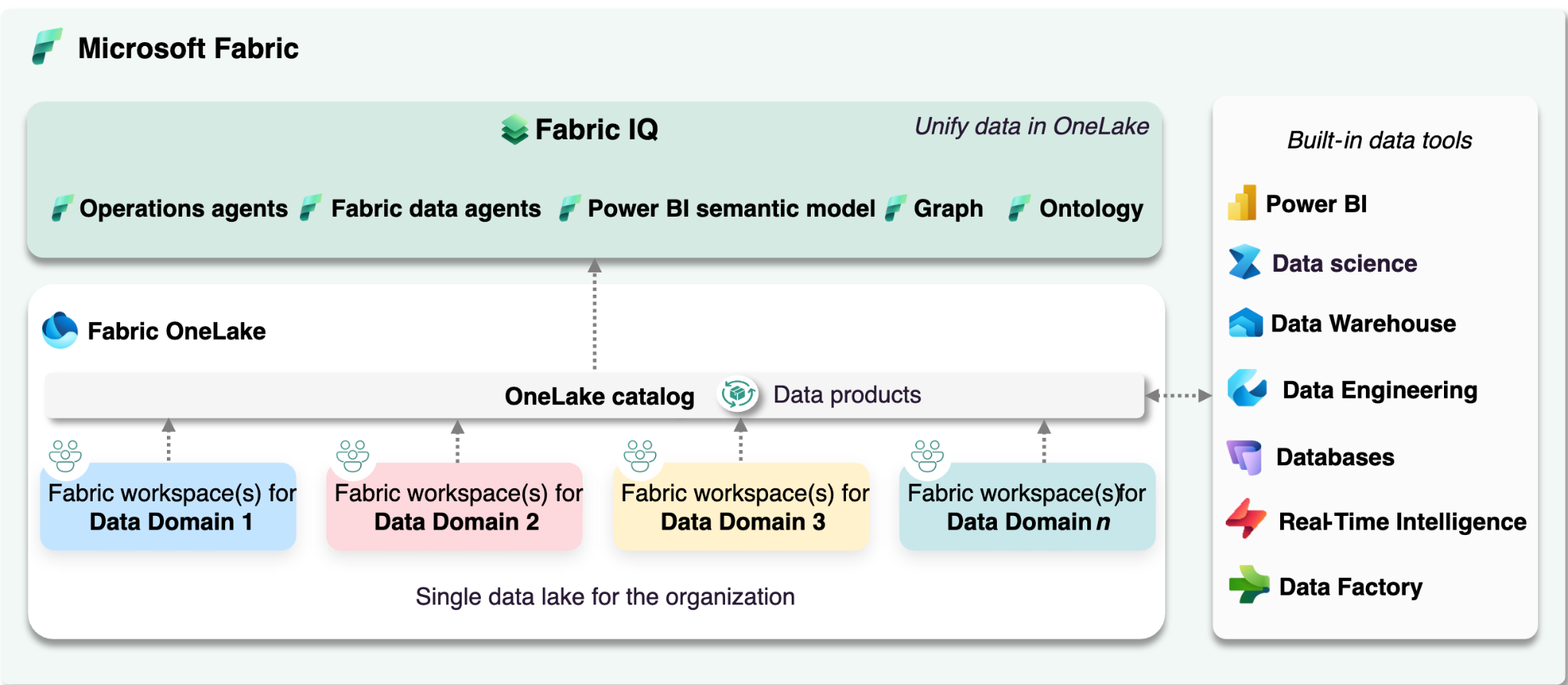
To solve the visibility crisis, you have to stop moving data between disconnected tools. Microsoft Fabric brings Data Engineering, Data Integration, Data Warehousing, Real-Time Analytics, Business Intelligence, and machine learning capabilities together into a single, cohesive platform.
At the center of this architecture is OneLake, Microsoft’s unified data layer. Think of it as the OneDrive for your enterprise data.
Instead of building complex, fragile pipelines to copy information from one silo to another, manufacturers can centralize and govern data directly from:
- ERP and MES platforms
- IoT devices and production equipment
- Inventory and supply chain applications
- Quality management systems
The result is a single source of truth: a trusted, governed, and highly scalable foundation ready for real-time analytics.
Where Cyann Delivers Value
Technology alone does not solve manufacturing challenges. Microsoft Fabric is the engine, but success depends on connecting that technology to your specific business objectives.
That is where Cyann steps in. We combine deep industry knowledge with technical expertise to build production-ready systems.
Cyann helps manufacturers:
- Modernize Data Architecture: We build scalable, resilient foundations that seamlessly bridge operational technology and enterprise IT systems.
- Improve Data Governance: We establish clear data ownership, strict security protocols, quality standards, and compliance controls.
- Enable Real-Time Visibility: We design and deploy automated dashboards that deliver accurate, second-by-second operational insights.
- Prepare for Advanced Analytics: We create the trusted, unified data environments required to power predictive maintenance, demand forecasting, and data-driven decision-making.
- Reduce Reporting Complexity: We eliminate manual data entry and spreadsheet dependencies.
Practical Manufacturing Use Cases
To optimize for Answer Engines and Generative AI search platforms, we have formatted the most common real-world applications into direct answers:
How can manufacturers improve Overall Equipment Effectiveness (OEE)?
By combining machine-level IoT data with production schedules in Microsoft Fabric, organizations can identify micro-stops and root causes of inefficiency in real time.
How does unified data reduce unplanned downtime?
Integrating maintenance logs with live sensor telemetry allows engineering teams to deploy proactive maintenance alerts before a machine actually fails.
How can supply chain visibility be improved?
By centralizing ERP, supplier, and logistics data, supply chain managers can optimize inventory levels to free up working capital without risking stockouts.
Building the Foundation for Smarter Manufacturing
As the manufacturing industry becomes increasingly competitive, organizations need more than just a new set of dashboards. They need a trusted foundation that connects disparate systems, enforces data governance, and enables intelligent, rapid-fire decision-making.
Microsoft Fabric provides that foundation. Cyann helps you turn it into measurable business value.
For manufacturers looking to break down silos, improve operational visibility, and prepare for the future of connected operations, the journey does not start with an algorithm. It starts with a unified data strategy.
Ready to stop reconciling reports and start optimizing your plant floor?
Connect with the experts at Cyann.ai today.
Academic Foundations & Further Reading
- Duan, L., & Da Xu, L. (2021). "Data Analytics in Industry 4.0: A Survey." Information Systems Frontiers, 26, 2287-2303. This comprehensive survey highlights how smart manufacturing decisions require a unified data approach to bridge cyber-physical systems. View Paper
- Liu, Z., et al. (2022). "The architectural design and implementation of a digital platform for Industry 4.0 SME collaboration." Computers in Industry, 138. This paper details the necessity of unified digital platforms to enable supply chain collaborations and reduce system integration barriers. View Paper
- Aggarwal, P., et al. (2024). "GEO: Generative Engine Optimization." Proceedings of the 30th ACM SIGKDD. The foundational paper defining how web content must be structured, cited, and formatted to rank effectively in AI-driven search engines. View Paper
- Chen, M., et al. (2025). "Generative Engine Optimization: How to Dominate AI Search." arXiv:2509.08919. Recent State-of-the-Art research proving that generative search engines heavily prioritize content backed by authoritative sources and clear, scannable structuring. View Paper

San Diego, CA 92121